
Feminism is the radical view that women* are human beings.
This means that women* should have the same rights as everyone else—human rights, in other words. And not just on paper, but in practice as well. The fact is,
however, that even in Western countries, at least the following human rights are not guaranteed for women*:
- The right to physical safety
- The right to equal pay for equal work
- The right to be protected from discrimination
The right to physical integrity
Violence Against Women*
According to a study by Amnesty International, one in six women in Switzerland experiences severe sexual violence, and at least one in three is harassed. One in twelve is raped.
Added to this is physical violence, including murder. In 2025 alone, at least 27 women were killed in Switzerland simply because they were women. (source: stopfemizid.ch). This means that in 2025, femicides accounted for over 49% of all (55) homicides in Switzerland.
Nevertheless, neither curbing domestic violence nor combating sexual violence is a political priority. The only logical conclusion is that women* in Switzerland do not have the same human rights as men. So far, there has been minimal willingness to change this.
The Gender Health Gap
Many diseases that specifically affect women have not been adequately researched. Even common diseases in women are diagnosed later than in men, and symptoms of diseases specific to women often go unrecognized. Furthermore, women receive treatments that are less tailored to their needs than men do. This leads to more side effects and poorer prognoses.
A key cause of these inequalities is that research is disproportionately often conducted on men—or on male cells and laboratory animals. The female menstrual cycle is often considered as too complicated.
It is assumed that conducting research on women or female laboratory animals would skew the results or make them unclear. At the same time, gender-specific data is difficult to access, and knowledge about relevant differences is not sufficiently incorporated into clinical practice “Unfortunately,” however, 50% of the world’s population is female. The fact that they then receive inferior medical care is tacitly accepted.
Here, too, the political will to change this is minimal.
The right not to be discriminated
Overtime, Pension Shortfalls, and Poverty in Old Age
Women between the ages of 15 and 64 in Switzerland earn 43% less than men, even though in 2024they worked an average of 3.1 hours more per week than men—namely, 61.1 hours, compared to 57.8 hours for men. This figure includes both paid and unpaid work. This is what the GOEG indicates (source: bfs.admin.ch).
The GOEG also takes into account women’s lost earnings due to caring for children and the elderly, as well as the fact that so-called “female” occupations are paid less than so-called “male”occupations requiring similar qualifications. It also accounts for direct gender-based discrimination.
The fact that essential care work—which is primarily performed by women—remains mostly unpaid also has serious consequences for women*: in old age or in the event of a separation, they must therefore accept reduced pension benefits. Quite a few are consequently forced to live in poverty, even though they have worked their entire lives—more so than the average man, whose lifestyle is rewarded with a higher salary and a larger pension. This is discriminatory. The unpaid work, which is largely performed by women*, is the backbone of our economy and far exceeds paid work. Nevertheless, it is not adequately recognized by society, and those (mostly women*) who perform it must accept disadvantages as a result.



The right to equal pay for equal work.
In Switzerland, women still earn 18% less than men in similar occupations. 10 to 11% of this pay gap can be explained by the fact that women are more likely to work part-time, take more career breaks, and engage in fewer salary negotiations. 7–8% of this difference can be attributed solely to discrimination.
What this analysis fails to take into account is that women* are already at a disadvantage in the selection process for skilled professions. A woman who holds a skilled position is therefore already more qualified than many of her male colleagues—otherwise, she would not have been hired in the first place. The fact that women* nevertheless earn less on average than men* is therefore all the more striking.
Furthermore, it is no coincidence that “women’s jobs” are generally paid less than “men’s jobs” that require similar qualifications: Studies have shown that the wage level in an industry changes depending on its gender composition. It is therefore not the case, as is commonly assumed, that women* just happen to work more often in lower-paying industries. The reality is that so-called “women’s jobs” are paid less because the majority of those who perform them are women*
The connection between feminism and spirituality
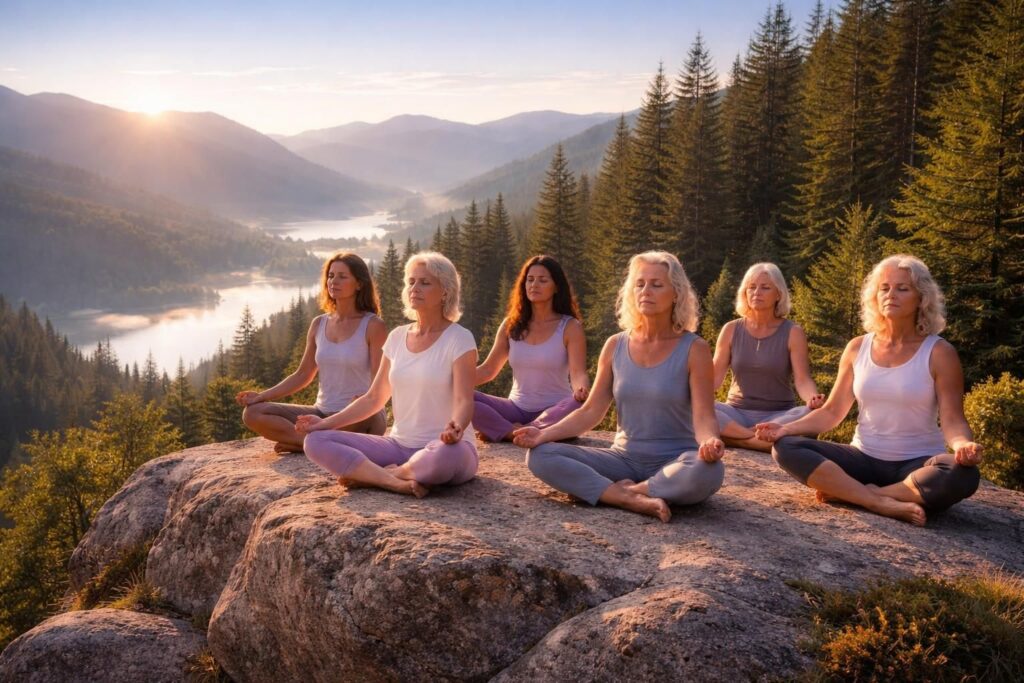
People who are constantly pushed to their limits and overworked don’t have time to engage with spirituality. More often than not, these people are women*. This is neither a coincidence nor a biological fact, but rather a direct consequence of our social order. True spirituality requires a deep engagement with oneself and—above all—with one’s own weaknesses and dark sides. Such a radical confrontation with one’s own emotional abysses requires strong self-confidence, patience, courage, self-love, and the knowledge that you’re okay just the way you are, even if you’re not perfect.
Yet self-confidence and self-love, in particular, are things that women* are not taught in our society. We learn to be kind, to please others, and to keep ourselves down. But those who are kind, who always want to please, and who keep themselves down for the sake of others will never muster the courage to face themselves with complete honesty, in all their facets. Even more so, since this might mean not to do what other people expect of them, but rather, what they feels is right.
That is why feminism is indispensable for genuine spirituality.
When women* turn to spiritual teachers who espouse misogynistic ideologies, it is very easy for their self-esteem and identity to be completely undermined before they even realize what has happened. Instead of finding themselves and their connection to the greater whole, they encounter external control, imposed, discriminatory values, and a disregard for their own human dignity. Of course, this can also happen to men*, but the risk is significantly greater for women*.
An alarming number of spiritual teachers* promote a theory about the natural differences between the sexes that explicitly or implicitly devalues women* and makes it impossible for their followers to simply be themselves. These theories go hand in hand with rigid role models. Although these teachings are primarily directed against women*, non cis men and gay men, they also harm heterosexual cis men. For even if heterosexual cis men are assigned the dominant role, it is a fixed attribution—a mental prison that prevents them as well from finding their own path.
Furthermore, such rigid theories about gender roles provide fertile ground for sexual harassment, transphobia, homophobia, the exploitation of women* and children, and, in some cases, sexual abuse.